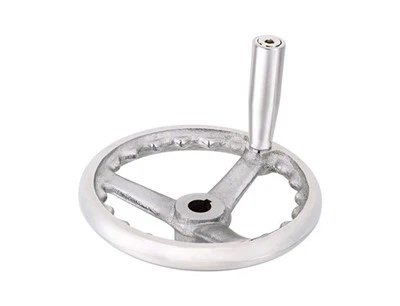
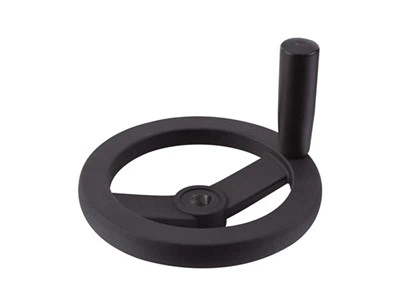
Walking into a modern precision manufacturing workshop, rows of CNC machine tools stand neatly arranged. The silver-gray or black handwheel with its smooth, delicate surface on the control panel always attracts the operator's attention first. In the precision world of CNC machine tools, constructed of steel, this small handwheel may seem insignificant, but it is the first point of contact between human and machine. Careful observation reveals that high-end CNC machine tools almost exclusively use aluminum alloy handwheels, rather than the traditional cast iron material. Today, we will provide an in-depth analysis of why this "control wheel" has become a standard feature of high-end machine tools.
I. The Lightweight Revolution: A Fundamental Leap from Heavy Cast Iron to Lightweight Aluminum Alloy
In the evolutionary history of CNC machine tools, the change in handwheel materials reflects a profound transformation in manufacturing philosophy. Traditional cast iron handwheels carry the heavy genes of the industrial age, with a density as high as 7.2g/cm³. A cast iron handwheel with a diameter of 200mm often weighs several kilograms. For workers who need to operate CNC machine tools for extended periods and at high frequencies, such heavy control components can accelerate arm fatigue and affect operational accuracy.
Aluminum alloy handwheels, however, have a density only about one-third that of cast iron, achieving extreme lightweighting. This "weight reduction" not only reduces the operator's labor intensity but also represents a qualitative leap in ergonomics. When workers need to frequently adjust the tool holder position and repeatedly perform tool setting operations, the lightweight feel of the aluminum alloy handwheel makes each turn effortless and reduces fatigue during long working hours. This focus on operator experience is the core embodiment of the human-centered design of high-end CNC machine tools.
II. Corrosion Resistance and Aesthetic Pursuit: The Enhanced Texture of Anodizing CNC machine tools often operate in complex environments-splashing cutting fluid, humid air, and even the presence of certain corrosive media all place stringent demands on the durability of machine tool accessories. One of the biggest drawbacks of cast iron handwheels is their susceptibility to rust, requiring complex surface treatments (such as chrome plating and painting) for protection. Once the coating is damaged, corrosion spreads rapidly.
Aluminum alloy handwheels inherently possess excellent corrosion resistance. A dense oxide film naturally forms on their surface, effectively preventing the intrusion of moisture and corrosive media. More importantly, through anodizing, the aluminum alloy surface not only achieves a protective layer far exceeding that of natural oxide films but also displays a rich variety of colors-classic black, technological silver, and even striking blue and red. This customizable aesthetic characteristic makes aluminum alloy handwheels a finishing touch for enhancing the overall quality and brand recognition of high-end CNC machine tools. Those silver-gray matte aluminum alloy handwheels complement the clean appearance of modern machine tools, jointly constructing the quality impression of high-end equipment.
III. Hand Feel and Precision Control: The Delicate Balance of Human-Machine Interaction
Operating a CNC machine tool is essentially a precise dialogue between humans and machines. And aluminum alloy handwheels... High-end CNC machine tools pursue precision down to the micrometer level; every subtle movement of the operator needs to be precisely transmitted. The excellent plasticity of aluminum alloy allows for precise machining of handwheel surface textures, anti-slip designs, and grip curvature according to ergonomic principles.
More importantly, some high-end aluminum alloy handwheels integrate corrugated springs and damping mechanisms, generating uniform "ripple feedback" or "locking feel" during rotation, allowing the operator to clearly perceive the feed amount corresponding to each rotation. This subtle tactile feedback is crucial for operations such as precision tool setting and fine-tuning coordinates.
IV. Comprehensive Performance and Safety Considerations: A Rational Choice for Modern Manufacturing
Whether the strength and wear resistance of aluminum alloys are sufficient for harsh industrial environments is a question. Modern high-strength aluminum alloys (such as ZL101A) already meet the mechanical properties of most CNC machine tools. Within the normal operating torque range, the strength of aluminum alloy handwheels is more than sufficient, and their good toughness makes them less prone to breakage under accidental impact, making them safer than more brittle cast iron.
Furthermore, for scenarios requiring rapid rotation, the design of solid disc aluminum alloy handwheels eliminates the safety hazard of fingers getting caught in the spokes, further enhancing operational safety. The reduced weight and lower inertia allow for more agile and precise operations, including rapid starts, stops, and frequent reversals.
From a materials science perspective, the choice between cast iron and aluminum alloy is not simply a matter of "which is better," but rather "which is more suitable." In heavy-duty valves or rugged industrial environments requiring extreme torque, cast iron still holds an irreplaceable position. However, for high-end CNC machine tools that demand a high degree of unity between precision, efficiency, user experience, and aesthetics, aluminum alloy handwheels are undoubtedly a more fitting answer to the spirit of the times.
They are lightweight yet not frivolous, beautiful without being gaudy, and durable without being clumsy. When the operator's fingertips lightly touch the precision-machined aluminum alloy handwheel, a story about precision and efficiency quietly begins with that slight touch. As a crucial machine tool accessory, the aluminum alloy handwheel tells us that true craftsmanship is often hidden in the most subtle operations.