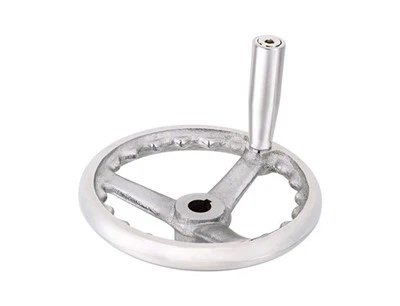
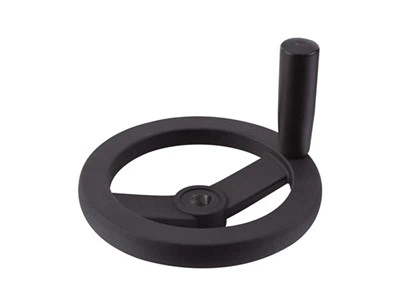
When purchasing round-rim handwheels, many buyers focus solely on three factors: outer diameter, material, and price. If the dimensions match, the material seems acceptable, and the price is right, they finalize the order. However, after the handwheel is installed on the machine tool and used for a few months, problems gradually emerge-such as a stiff or gritty feel, a loose handle, surface peeling, or a failure to lock securely. These issues often stem from seemingly insignificant details that were easily overlooked during the purchasing process.
Detail 1: Focusing only on bore diameter while ignoring tolerances
This is the most common-and critical-oversight.
When reviewing specifications, many buyers check only the "bore diameter (d)." They assume that if the shaft diameter is 12mm, a handwheel with a 12mm bore will provide a perfect fit. In reality, however, both shaft machining and handwheel bore manufacturing involve tolerances. If the tolerance fit is incorrect, the handwheel either won't fit at all or will fit loosely and wobble.
During procurement, it is essential to confirm not just the bore diameter value but also the tolerance range (such as fit classes like H7). For handwheels with keyways, the width, depth, and length of the keyway must also precisely match the keyway on the machine tool's shaft. Even a tiny discrepancy can cause wobbling after installation, rendering even a high-quality handwheel useless.
Detail 2: Surface smoothness-a matter of longevity, not just aesthetics
A high-quality round-rim handwheel should have a smooth, intact surface free from scratches or damage. However, many buyers equate "smoothness" merely with "good looks," assuming that as long as functionality isn't impaired, the finish doesn't matter.
In fact, the quality of the surface treatment directly determines the handwheel's corrosion and wear resistance. Premium handwheels undergo standardized processes such as sandblasting, chrome plating, or powder coating. In contrast, inferior products often feature thin coatings with poor adhesion; when exposed to machine oil and cutting fluids, these coatings begin to peel or flake within months. This not only compromises the tactile feel but also accelerates wear on the rim. Physically touching the surface or gently scratching it with a fingernail during procurement is often far more effective than simply looking at product photos.
Detail 3: Chamfering-Small Details, Major Risks
The edges of the handwheel, the junctions of the spokes, and the ends of the handle-many purchase orders fail to specify whether these areas have been rounded or blunted.
Yet, this seemingly insignificant detail directly impacts operator safety. Sharp, unchamfered edges can slice through gloves or even cut the skin when the operator repeatedly turns the handwheel. More importantly, sharp edges are often points of stress concentration, making them more prone to cracking under long-term load. When purchasing, always verify that all handwheel edges have been rounded.
Detail 4: Handle Compatibility and Selection
Handwheels with round rims come in two structural types: Type A (without a handle) and Type B (with a handle). Many purchasers simply confirm whether a handle is needed but overlook the specific handle options available.
For Type B handwheels, the handle is not always an integrated standard feature; it often needs to be selected separately. Options include fixed handles, curved handles, revolving handles, and folding handles. Different handle types suit different operating habits and spatial constraints. Failure to specify the handle type and mounting method at the time of purchase can lead to issues-such as the handle not fitting at all or proving awkward to operate once installed.
Detail 5: Confirming the Connection Method
Connecting a handwheel to a shaft involves more than just slipping it on. Common connection types include keyway bores, set-screw locking, square bores, and solid (unbored) hubs. You must clarify the structure of the machine tool's shaft end during procurement: Is it a smooth shaft with a keyway, a threaded shaft, or a square shaft? Different shaft types require matching handwheel mounting methods.
If you purchase a set-screw locking handwheel for a shaft with a keyway, installation relies on forcing a set screw against the shaft; this causes slippage when torque is applied. Conversely, if you buy a keyway-style handwheel for a smooth shaft, it cannot be installed at all. While this detail may seem basic, errors regarding it occur frequently in actual procurement.
Point 6: Manufacturer Craftsmanship and After-Sales Support-Look Beyond Price
The handwheel market is currently rife with cutthroat competition based on product homogeneity; unable to keep pace in terms of technology and quality, some smaller manufacturers resort to competing solely on price. While prices may be lower, product quality is often inconsistent, and after-sales support is frequently nonexistent.
When sourcing, do not rely solely on technical specifications or a few product photos provided by the manufacturer. If possible, visit the production facility to inspect the manufacturing environment and processes firsthand. Furthermore, prioritize well-known brands or suppliers with strong reputations to ensure both product quality and reliable after-sales service. After all, the handwheel serves as the "control interface" for machine tools and sees daily use; substandard quality can have significant, far-reaching consequences.
Purchasing a round-rim handwheel may appear to be a simple matter of buying a "wheel," but in reality, you are acquiring a critical component that directly impacts operational precision, safety, and equipment longevity. Merely matching dimensions meets only the bare minimum requirement; only by carefully verifying the often-overlooked details mentioned above can you truly ensure you are purchasing a high-quality handwheel.