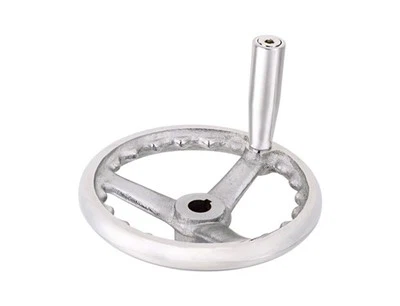
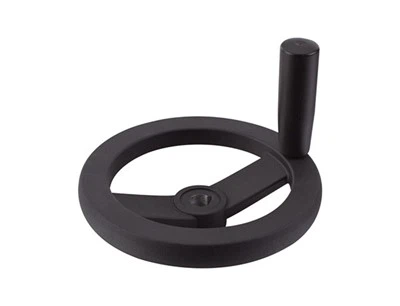
Yes, handwheels can be manufactured using the die-casting process.
I. Introduction to Die-Casting
Die-casting, also known as pressure casting or high-pressure casting, is a metalworking method in which liquid or semi-liquid metal fills a mold cavity at extremely high speed and solidifies under pressure to produce a die-cast part. This method can produce metal parts with complex shapes, clear contours, thin walls, and deep cavities. Due to their advantages such as high dimensional accuracy, low surface roughness, and good interchangeability, die-cast parts are widely used in many fields.
II. The Feasibility of Die-Casting Handwheels
Handwheels are common mechanical components, often used to adjust or control equipment. Given the characteristics of the die-casting process, handwheels can be manufactured using die-casting. Die-cast handwheels maintain high dimensional accuracy and surface quality, which is crucial for handwheels requiring precise adjustment. Furthermore, die-casting allows for mass production, improving production efficiency and reducing the cost of each product.
III. Advantages and Disadvantages of Die-Casting Handwheels
Die-cast handwheels have the following advantages: high dimensional accuracy, ensuring precise adjustment; excellent surface quality, enhancing product aesthetics and durability; and high production efficiency, making them suitable for large-scale production. However, die-casting also has some disadvantages, such as high mold costs, making it unsuitable for small-batch production; and the potential for defects such as pores and shrinkage during the die-casting process, requiring strict control of process parameters.
IV. Comparison of Other Manufacturing Processes
In addition to die-casting, handwheels can also be manufactured using casting, forging, and machining. Cast handwheels are less expensive, but suffer from lower precision and surface quality; forged handwheels offer better mechanical properties and durability, but are more expensive and require a longer production cycle; and machined handwheels offer high precision, but lower material utilization and a relatively high cost. In comparison, die-casting offers certain advantages in terms of precision, surface quality, and production efficiency.