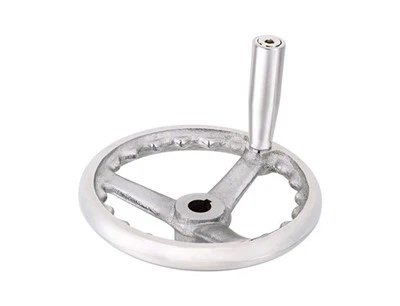
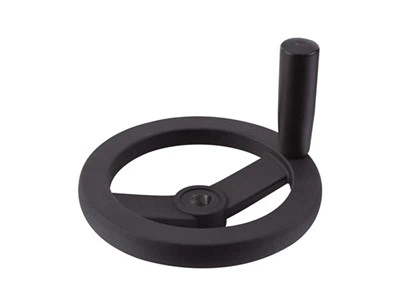
A handwheel is based on the principle of leverage. By rotating a central axis and surrounding spokes, it enables lifting, moving, and transporting heavy objects. Here's how to use a handwheel:
- Secure the central axis of the handwheel to the machine or object to be operated to ensure smooth rotation.
- Press the handwheel's locking mechanism to secure the handwheel in place, preventing it from moving during operation.
- Grip the handwheel handle firmly and press down. This allows the spokes to contact the ground, providing friction, thereby moving the object forward or upward.
- To lower or move the object, lift the handle upward to lift the spokes off the ground, reducing friction and allowing the object to be lowered or moved easily.
The principle of a handwheel can be explained with a simple example. Imagine a handwheel with four spokes and a central axis fixed to a vertical column. When the handle of a handwheel is pressed downward, the contact area between each spoke and the ground generates an upward force. This force is transmitted to the column through the central shaft, generating an upward torque, lifting or moving the load forward. When the handle of the handwheel is lifted upward, each spoke loses contact with the ground, reducing the torque transmitted by the central shaft, allowing the load to be lowered or moved backward with ease.
In short, the handwheel's operating principle is based on the lever principle. By rotating the central shaft and the surrounding spokes, heavy objects can be lifted, moved, and transported. Handwheels are simple, flexible, and convenient to operate, and are widely used in industry, transportation, logistics, and other fields.