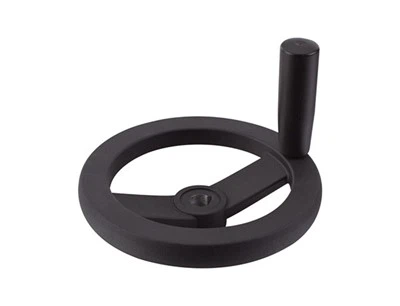
In the realm of industrial and mechanical control systems, the choice of knobs plays a pivotal role in ensuring precision, efficiency, and user comfort. Among the various types of knobs available in the market, three - arm knobs have emerged as a popular option. As a supplier of three - arm knobs, I am often asked whether these knobs are suitable for precision control. In this blog, I will delve into the characteristics of three - arm knobs, their advantages and limitations in precision control scenarios, and compare them with other types of knobs.
Characteristics of Three - Arm Knobs
Three - arm knobs, as the name suggests, feature three arms or protrusions extending from the central hub. These arms are designed to provide a better grip for the user, allowing for easy rotation and adjustment. The shape and design of the arms can vary, with some being straight, while others may be curved or angled. This variation in design can affect the user's grip and the amount of torque that can be applied.
One of the key features of three - arm knobs is their ergonomic design. The three - arm configuration allows the user to place their fingers comfortably around the knob, reducing hand fatigue during prolonged use. This is particularly important in applications where the user needs to make frequent adjustments, such as in laboratory equipment, control panels, and machinery.
Advantages of Three - Arm Knobs for Precision Control
Enhanced Grip and Torque
The three - arm design provides a superior grip compared to single - or two - arm knobs. This enhanced grip allows the user to apply more precise and controlled torque when turning the knob. In precision control applications, such as adjusting the focus of a microscope or setting the speed of a motor, the ability to apply a consistent and accurate amount of torque is crucial. The three - arm knob's design enables the user to make fine adjustments with greater ease and accuracy.
Visual Feedback
The multiple arms of the three - arm knob also provide visual feedback to the user. As the knob is turned, the movement of the arms is more noticeable than that of a single - arm knob. This visual feedback can help the user to better judge the amount of rotation and make more precise adjustments. For example, in a control panel where the user needs to set a specific parameter, the visual movement of the three - arm knob can assist in achieving the desired setting more accurately.
Versatility
Three - arm knobs are highly versatile and can be used in a wide range of applications. They are available in different sizes, materials, and finishes to suit various requirements. Whether it is a small, delicate instrument or a large industrial machine, there is a three - arm knob that can be customized to fit the specific application. This versatility makes them a popular choice among designers and engineers.
Limitations of Three - Arm Knobs for Precision Control
Space Constraints
In some applications, the three - arm design may pose space constraints. The extended arms of the knob require more space around the control point, which may not be available in compact or densely packed equipment. In such cases, a single - or two - arm knob may be a more suitable option.


Over - rotation Risk
The enhanced grip and ease of use of three - arm knobs can sometimes lead to over - rotation. If the user is not careful, they may turn the knob too far, resulting in an incorrect setting. This can be a problem in applications where precise control is critical, such as in medical devices or aerospace equipment.
Comparison with Other Types of Knobs
Knurled Clamping Knobs
Knurled Clamping Knobs are another popular type of knob used in precision control applications. These knobs feature a knurled surface, which provides a good grip. However, compared to three - arm knobs, they may not offer the same level of ergonomic comfort and visual feedback. The knurled surface is mainly designed for gripping, while the three - arm knob's design combines both grip and visual cues for better precision control.
Black Knurled Knobs
Black Knurled Knobs are similar to knurled clamping knobs but are often used for aesthetic reasons in addition to functionality. The black finish can give a more professional and sleek look to the equipment. However, like knurled clamping knobs, they may lack the ergonomic advantages and visual feedback provided by three - arm knobs.
Mushroom Type Knobs
Mushroom Type Knobs have a rounded, mushroom - shaped head. They are easy to grip and are commonly used in applications where a large surface area for gripping is required. However, they may not be as suitable for precision control as three - arm knobs. The rounded shape of the mushroom type knob may make it more difficult to apply precise torque and judge the amount of rotation.
Applications Where Three - Arm Knobs Excel in Precision Control
Laboratory Equipment
In laboratory settings, precision is of utmost importance. Three - arm knobs are commonly used in equipment such as pipettes, burettes, and spectrometers. The ergonomic design of the three - arm knob allows laboratory technicians to make fine adjustments to the equipment without causing hand fatigue. The visual feedback provided by the arms also helps in achieving accurate settings, which is crucial for obtaining reliable experimental results.
Control Panels
Control panels in industrial and commercial settings require precise control of various parameters. Three - arm knobs are often used in these panels to adjust settings such as temperature, pressure, and speed. The enhanced grip and visual feedback of the three - arm knob make it easier for operators to make accurate adjustments, reducing the risk of errors and improving overall system performance.
Conclusion
In conclusion, three - arm knobs are generally well - suited for precision control applications. Their enhanced grip, visual feedback, and ergonomic design make them a popular choice in a wide range of industries. However, they do have some limitations, such as space constraints and the risk of over - rotation, which need to be considered in specific applications.
When compared to other types of knobs, such as knurled clamping knobs, black knurled knobs, and mushroom type knobs, three - arm knobs offer unique advantages in terms of precision control. Their versatility also allows them to be used in various applications, from small laboratory instruments to large industrial machinery.
If you are in the market for high - quality three - arm knobs for your precision control needs, I encourage you to reach out to us. Our team of experts can help you select the right knob for your specific application and provide you with customized solutions. We are committed to providing the best products and services to our customers, and we look forward to the opportunity to work with you on your next project.
References
- "Ergonomic Design of Control Knobs for Precision Applications" - Journal of Industrial Design
- "Comparison of Different Types of Knobs in Precision Control Systems" - Proceedings of the International Conference on Mechanical Engineering