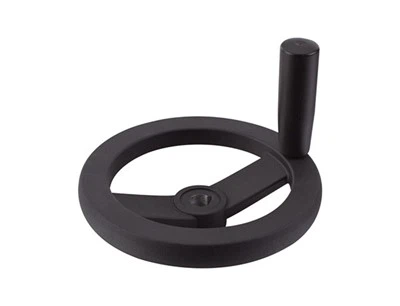
Do two - spoke handwheels have any self - centering features?
Hey there! I'm a supplier of Two-spoke Handwheels, and I often get asked this question: Do two - spoke handwheels have any self - centering features? Well, let's dive right in and explore this topic.
First off, let's understand what self - centering means in the context of handwheels. Self - centering refers to the ability of a handwheel to return to a central or neutral position on its own after being rotated or displaced. This feature can be super useful in many applications, like in machinery where precise positioning is crucial.
Now, when it comes to two - spoke handwheels, the self - centering aspect isn't as straightforward as you might think. Unlike some specialized handwheels that are designed specifically with self - centering mechanisms built - in, two - spoke handwheels don't inherently have a strong self - centering feature.
The design of a two - spoke handwheel is relatively simple. It consists of two spokes connected to a hub, and you grip these spokes to turn the wheel. The simplicity of this design is great for ease of use and cost - effectiveness, but it doesn't lend itself well to self - centering. There's no built - in spring or other mechanism that would automatically pull the wheel back to a central position.
However, that doesn't mean two - spoke handwheels can't be used in applications where self - centering is desired. In some cases, you can pair a two - spoke handwheel with an external self - centering device. For example, you could use a spring - loaded mechanism attached to the shaft that the handwheel is mounted on. When the handwheel is turned, the spring stores energy, and when you release the handwheel, the spring releases that energy and tries to return the handwheel to its original position.
Another way to achieve a form of self - centering with two - spoke handwheels is through the use of a detent system. A detent is a small, spring - loaded ball or pin that fits into a notch or groove. When the handwheel is turned, the detent moves out of the notch, and when you let go, it snaps back into place, which can give the impression of self - centering. This method is often used in applications where you need to set the handwheel at specific, predefined positions.
Let's compare two - spoke handwheels with 3 Spoke Handwheel. Three - spoke handwheels have an extra spoke, which can provide a bit more stability and balance when turning. But in terms of self - centering, they face the same basic limitations as two - spoke handwheels. They don't have an inherent self - centering ability either, and would also rely on external mechanisms if self - centering is required.
On the other hand, Aluminum Alloy Handwheel might offer some advantages in terms of weight and corrosion resistance. But again, the self - centering feature isn't determined by the material. Whether it's an aluminum alloy or another material, the self - centering depends on the design and any additional mechanisms used.
So, why would you still choose a two - spoke handwheel even without a strong self - centering feature? Well, there are several reasons. For one, they're easy to grip. The two - spoke design allows for a comfortable and natural hand position, which can reduce fatigue during long - term use. They're also lightweight, which can be beneficial in applications where weight is a concern. And let's not forget about cost. Two - spoke handwheels are generally more affordable than some of the more complex handwheel designs with built - in self - centering features.
In industrial applications, two - spoke handwheels are commonly used in conveyor systems, small machinery, and control panels. In these settings, the focus is often on ease of operation rather than precise self - centering. For example, in a conveyor system, you might use a two - spoke handwheel to adjust the speed or tension. You don't necessarily need the handwheel to return to a specific position on its own; you just need to be able to make the adjustment easily.


In conclusion, while two - spoke handwheels don't have a built - in self - centering feature, there are ways to achieve a form of self - centering through external mechanisms. Their simplicity, ease of use, and affordability make them a popular choice in many applications. If you're in the market for handwheels and have questions about self - centering or any other features, don't hesitate to reach out. We're here to help you find the right handwheel for your specific needs. Whether you're looking for a basic two - spoke handwheel or something more specialized, we've got you covered.
If you're interested in purchasing our Two-spoke Handwheels or want to discuss your requirements further, feel free to get in touch. We're always happy to have a chat about how our products can fit into your projects.
References
- Engineering Design Handbook: General Machine Design, U.S. Army Materiel Command
- Machinery's Handbook, Industrial Press Inc.